
Q.1. A colour-blind father has a daughter with normal vision. The daughter marries a man with a normal vision. What is the probability of her children to be colour blind? Explain with the help of a pedigree chart.
Answer-
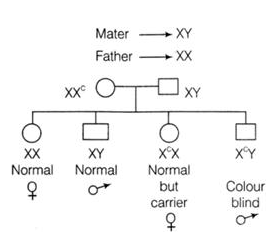
Q.2. A tall plant with red flowers (dominant) is crossed with a dwarf plant with white flowers (recessive). Work out a dihybrid cross and state the dihybrid ratio. What will be the effect on the dihybrid ratio if the two genes are interacting with each other?
Answer-

The standard dihybrid ratio observed is 9:3:3:1. If the two genes interact with the values will deviate. This is because when the genes are linked they do not exhibit independent assortment and remain together in the gametes and the offsprings. The dihybrid ratio thus obtained is 3:1.
Q.3. What is aneuploidy? Differentiate between aneuploidy and polyploidy.
Answer- Aneuploidy is the chromosomal abnormality in which one or more chromosomes are gained or lost during meiosis due to the non-disjunction of chromosomes.
Differences between aneuploidy and polyploidy:
Polyploidy is a type of chromosomal aberration containing an entire extra set of chromosome. It may be triploid or tetraploid. This phenomenon is common in plants. It is, however, lethal in animals.
Q.4. Describe the individuals with the following chromosomal abnormalities:
1. Trisomy at chromosome 21
2. XXY
3. XO
Answer-
1) Trisomy– Trisomy results in an autosomal linked genetic disorder known as Down’s syndrome. The individuals exhibit the following characteristics:
- Protruding tongue
- Roundhead
- Slanting eyes
- Short height
- Open mouth
- Short neck
- Mental retardation
- Under-developed genitals and gonads
2) XXY– The presence of an additional copy of an X-chromosome results in Kleinfelter’s syndrome. The patient exhibits the following characteristics:
- The male individual possesses feminine characteristics.
- Development of breasts in males
- Male is sterile
- Poor beard growth
- Feminine voice
3) XO– Loss of X-chromosome results in Turner’s syndrome. Characteristics:
- The female is sterile.
- The ovaries are immature.
- Webbed neck
- Thorax is shield-shaped
- Under-developed breasts.
- Puffy fingers
- Short height
- Uterus is small
Q.5. Why is Drosophila used extensively for genetic studies?
Answer- Drosophila is extensively for genetic studies because it has the following characteristics:
- They have a life span of two weeks.
- They can be grown in the laboratory on simple synthetic medium.
- A large number of progenies are produced by a single mating.
- The male and the female Drosophila can be differentiated easily.
- It has many variations easily visible under a simple microscope.
Q.6.List out the characteristics of the chromosome theory of Inheritance.
Answer-
The important characteristics of the chromosome theory of Inheritance are:
1. Fertilization restores diploid condition.
2.Chromosomes segregate and assort independently.
3. Homologous chromosomes separate at the time of meiosis.
4. Both chromosomes, as well as genes, exist in pairs within the diploid cells.
5. Gamete contains only one chromosome of a particular type and only one of the two alleles of a character.
Q.7.Define autosome, hemizygous, homozygous, and heterozygous?
Answer-
- Autosome– All chromosomes apart from the sex chromosomes are called the Autosomes. The number of autosomes differs from one organism to another. Humans have 44 number or 22 pairs of autosomes.
- Hemizygous– It is a condition in which an organism has only one copy of a gene or DNA sequence present in diploid cells.
- Homozygous— It is a condition in which an organism has two similar alleles of a given gene (XX).
- Heterozygous–It is a condition in which an organism has two different alleles of a given gene (XY).
Q.8.What are Sex-linkage?
Answer- Sex linkage can be defined as the phenotypic expression of an allele, which is dependent on the individual’s gender. It describes the presentation of the chromosome and the sex-specific patterns of inheritance. Sex linkage is directly tied to the sex chromosomes – homogametic sex and heterogametic sex. In mammals, the homogametic sex (XX) is female and the heterogametic sex (XY) is male. Thus the sex-linked genes are carried on the X chromosome.
Q.9.Why is colour blindness more prominent in males than females?
Answer- Colour blindness is a sex-linked disorder and the genes responsible are present on the X-chromosome. To become affected by the disease, the female should possess the alleles for colour blindness on both the X-chromosomes. If the allele is present on only one chromosome, the female becomes a carrier of the disease. Since males have only one X-chromosome, it carrying the allele renders them affected. That is why males are more prone to colour blindness.
Q.10.Why did scientists select fruit flies for his genetics experiments?
Answer- Drosophila melanogaster is a small common fly species, which belongs to the family Drosophilidae. This species is generally known as the vinegar fly or a fruit fly.
In the year 1830, Drosophila melanogaster was established as a key model organism for biomedical science and it is due to the considerable biological similarity to mammals and an abundance of available genetic tools.
Like humans, these fruit flies species have a similar distribution of chromosomes. An individual with a pair of X chromosomes is female fruit fly and an individual with one X and one Y chromosome is male.

 Easy Biology