
Q.1. Fill in the missing boxes exhibiting the route of sperm transport.
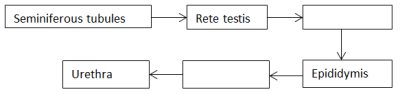
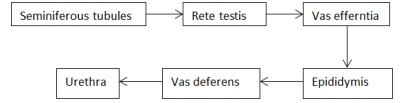
Answer- Following is the pathway followed by a sperm.
Q.2. List the following events observed in human reproduction in chronological order. Fertilization, gametogenesis, insemination, gestation, parturition, implantation.
Answer- Following is the sequence of events occurring in the process of human reproduction:
1. Gametogenesis
2. Insemination
3. Fertilization
4. Implantation
5. Gestation
6. Parturition
Q.3. State the significance of cervix in the female reproductive system.
Answer- The cervix is a narrow opening through which the uterus opens up to the vagina. The cervical canal is the cavity of the cervix which alongside the vagina goes on to form the birth canal.
Q.4. What is the reason for the absence of menstrual cycles during conception or pregnancy?
Answer- During pregnancy, all the events of the menstrual cycle stop and there is no menstruation. Menstruation occurs only when the egg that is released is not fertilized. But in pregnancy, the released egg is fertilized and hence the uterus lining does not shed, instead nourishes the fetus. However, a woman may experience uterine bleeding during pregnancy due to various reasons. It is not due to the period.
Q.5. Fill up the missing data in the table where Column A shows female reproductive organs and Column B shows its respective functions.
| Column A (Organs) |
Column B (Corresponding Functions) |
| Ovaries | Ovulation |
| Oviduct | |
| Pregnancy | |
| Vagina | Birth |
Answer- Following are the female reproductive organs and their associated functions.
| Column A (Organs) |
Column B (Corresponding Functions) |
| Ovaries | Ovulation |
| Oviduct | Fertilization |
| Uterus | Pregnancy |
| Vagina | Birth |
Q.6. Name the hormone crucial in parturition. Does the parturition signal originate from the mother or the fetus?
Answer- The hormone is Oxytocin. The signal originates from the placenta and fully developed fetus which initiate the foetal ejection reflex triggering the release of the hormone, oxytocin.
Q.7. State the role of the epididymis in male fertility.
Answer- It is situated along the posterior surface of each testis where spermatozoa acquire motility and the capacity to fertilize the egg. The surface of the sperm is altered in response to secretions of the epididymis which is key to achieve the ability to fertilize an egg.
Q.8. List the names of the hormones, endocrine glands along with functions of the hormones that are crucial in causing spermatogenesis.
Answer- The table below provides the required data:
| Name of the hormone | Endocrine glands where the hormone is released | Functions of the hormone |
| Gonadotropin-releasing hormone(GnRH) | Hypothalamus | Increase in secretion of GnRH initiates spermatogenesis at puberty age After acting on the anterior pituitary gland – triggers the secretion of LH and FSH |
| Luteinising hormone(LH) | Anterior pituitary gland | Triggers the production and secretion of androgens |
| Follicle Stimulating Hormone (FSH) | Pituitary gland | Acts on Sertoli cells and stimulates the secretion |
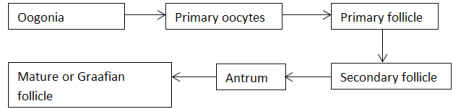
Q.9. Fill in the missing boxes for the levels in the transformation of mother germ cells into a mature follicle.
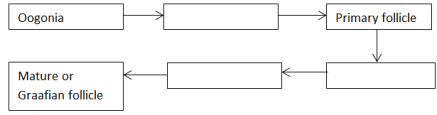
Answer- The various steps in the formation of the mature follicle are as follows:
Q.10. What are the events that cause the chromosome number of gametes to go from 2n, n, and again back to 2n during reproduction?
Answer- Chromosomes replicate once but divide twice. They undergo mitosis, first meiotic cell division and second meiotic cell division, the outcome of which is n number of chromosomes. They fuse with the haploid(n) sex gamete of the opposite sex to form a diploid(2n) cell during reproduction.
Q.11. How is a primary oocyte different from a secondary oocyte?
Answer- The primary oocyte is a diploid cell whereas secondary oocyte is a haploid cell. The primary oocyte is formed when oogonia are at the prophase-I of the meiotic division in the foetal ovary whereas secondary oocyte is formed from primary oocyte after meiosis – I division to produce ova in females during the stage of puberty.
Q.12. State the role of the ampullary-isthmic junction in the female reproductive tract.
Answer- In the ampullary-isthmic junction, fertilization of the ovum takes place.
Q.13. How is polyspermy checked by the zona pellucida of the ovum?
Answer- The zona pellucida is a thick layer that is girdled by corona radiata cells. During fertilization, cortical granules are released from the egg which blocks fusing of multiple sperms with an egg.
Q.14. What is the significance of LH surge through the menstrual cycle?
Answer- It triggers the rupture of Graafian follicle and causes the release of the ovum in the fallopian tube.
Q.15. During which stage of cell division are spermatids formed from the secondary spermatocytes?
Answer- The second meiotic division.

 Easy Biology