
Q.1. How does a chasmogamous bisexual flower prevent self-pollination?
Answer- A chasmogamous bisexual flower prevents self-pollination in the following ways:
1. Dichogamy: In this strategy, the release of pollens and the receptivity of stigma are not synchronized. For eg., in sunflower, the stigma becomes receptive long after the pollen release.
2. Herkogamy: In this, the male and female flowers are present at different locations. In this, the pollen of the flower cannot come in contact with the stigma of the same flower. For eg., Hibiscus gloriosa
3. Self-sterility: It is a mechanism in which the growth of the pollen tube in the pistil or the germination of pollen grains is inhibited. This prevents the fertilization of the ovules from the pollen of the same flower. For eg., Abolition.
Q.2. Arrange them sequentially according to how they appear in the artificial hybridization programme.
1. Rebagging
2. Selection of parents
3. Bagging
4. Dusting the pollen on the stigma
5. Emasculation
6. Collection of pollen
Answer- a) Selection of parents b) Emasculation c) Bagging d) Collection of pollen e) Dusting of pollen on the stigma f) Rebagging
Q.3. How do self-incompatibility restrict autogamy? How does pollination occur in such plants?
Answer- Self-incompatibility restricts autogamy by a mechanism known as self-sterility. This is a genetic mechanism in which the germination of pollen grains or the pollen tube growth in the pistil is inhibited which prevents the pollen from fertilizing the ovules. Such plants pollinate by the process of cross-pollination.
Q.4. Label the following diagram.
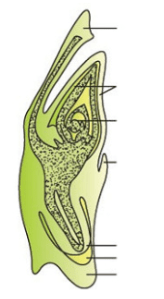
Answer-
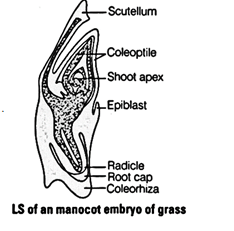
Q.5. Explain the term polyembryony. How is it exploited commercially?
Answer- When more than one embryo occurs in a seed, it is referred to as polyembryony. This can be seen in a few citrus fruits and mango varieties. Polyembryony plays a significant part in plant breeding and horticulture. These embryos give rise to virus-free plantlets and are healthy. Hybrid varieties of such plants and vegetables are being grown extensively. These varieties thus obtained are highly productive.
Q.6. Is there any difference between apomixis and parthenocarpy? Explain the benefits of each.
Answer- Yes, parthenocarpy is different from apomixis. In parthenocarpy, the fruit is produced without the fertilization of the female gamete. It is used for the production of fruits without seeds such as banana and grapes for commercial purposes. Apomixis is the process in which the seeds are produced without fertilization but the process occurs in the female reproductive tract of the plant. In this, the megaspore mother cell does not undergo meiosis. It is used for the commercial production of hybrid varieties and in the production of virus-free varieties.
Q.7. The zygote divides only after the division of the primary endosperm cell. Give reasons in support of the statement.
Answer- Zygote requires nourishment for its growth and division. This nourishment is provided by the primary endosperm cell. That is why the zygote divides only after the growth, food storage and division of the primary endosperm cell.
Q.8. Why is it that the generative cell of 2-celled pollen divides in a pollen tube and not of 3-celled pollen?
Answer- The generative cell divides to form two male gametes. In three-celled pollen, the generative cell divides into two gametes, therefore, no further division takes place in the pollen tube. However, in two-celled pollen, the generative cell moves down the pollen tube and divides to form two male gametes.
Q.9. Label the following parts in the diagram given below:
Male gametes, egg cell, polar nuclei, synergid, pollen tube.
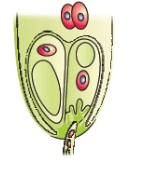
Answer-
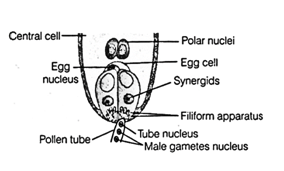
Q.10.Explain the events which occur after the process of fertilization in plants.
Answer-Fertilization is a vital process, which takes place in all sexually reproducing organisms. In all flowering plants, fertilization occurs after pollination and germination. After the process of fertilization, the following events occur:
- The ovary becomes the fruit
- The ovules become the seeds.
- The other structures including the corolla, calyx, and other remaining parts of the androecium and gynoecium degenerate or fall off.

 Easy Biology