
Q.1. What are the two inherent characteristics of amoeba and yeast that favour asexual reproduction in them?
Answer- The two inherent properties of amoeba that help them to reproduce asexually are:
- They have relatively simple structures and can divide very quickly.
- They are uniparental.
Q.2. “The offsprings produced by asexual reproduction are referred to as clones”. Why?
Answer- During asexual reproduction, there is no fusion of gametes and a single parent divides and redivides to produce the offsprings. Hence, the offsprings are morphologically and genetically similar to the parents and therefore referred to as clones.
Q.3. Why is potato tuber considered as a stem though it is an underground part? Give two reasons in support of your answer?
Answer- The potato is referred to as a stem because:
- It has nodes and internodes.
- It can form plantlets from the buds present over the nodes.
Q.4. Among the annual and the perennial plants, which one has a shorter juvenile period. Explain.
Answer- The entire life cycle of an annual plant has to be completed in one year which is shorter than that of the perennial plants. Hence, it has a shorter juvenile period.
Q.5. Rearrange the following events in the sequence in which they occur in the sexual reproduction of flowering plants: embryogenesis, fertilization, gametogenesis, pollination.
Answer- Pollination, Gametogenesis, Fertilization, Embryogenesis.
Q.6. How is it that the chances of fruit set in a self-pollinated bisexual flower of a plant are far greater than a dioecious plant?
Answer- In a bisexual flower, the anther and stigma lie close to each other. Thus, the transfer of pollen to stigma is easier than dioecious plants. However, in a dioecious plant, a pollinator is necessary to carry out pollination. Therefore, the chances of fruit set in a self-pollinated bisexual flower are far greater than a dioecious plant.
Q.7. Is sexual reproduction hindered by the presence of a large number of chromosomes in an organism?
Answer- No, Sexual reproduction is not hindered by a large number of chromosomes in an organism. A fern Ophioglossum has 1260 chromosome and still reproduces sexually. The chromosomes are present within the nucleus of a cell. The chromosomes divide and segregate in this compartment irrespective of its number. It generates haploid gametes during sexual reproduction.
Q.8. Explain giving two examples if there is a relationship between the size and the lifespan of an organism.
Answer- There is no relationship between the size and lifespan of an organism. For eg.,
- The size of a crow and a parrot is the same but a crow can live for 15 years while a parrot, 140 years.
- The mango tree and the banyan tree have the same size but the lifespan of a mango tree is shorter than that of the banyan tree.
Q.9. There are two different types of flowers marked A and B in the image given below. Identify the flower types and the kind of pollination that will occur in each of them.
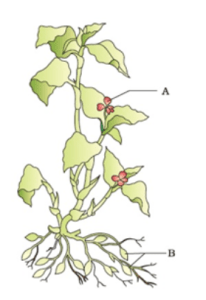
Answer- A- Chasmogamous Flower (these remain open exposing the anther and stigma) B- Cleistogamous Flower (these remain closed) The type of pollination that will occur in this plant is Cleistogamy, a type of autogamy in which plants possess both chasmogamous and cleistogamous flowers. In this, the chasmogamous flowers may undergo self-pollination or cross-pollination, and the cleistogamous flowers may undergo only self-pollination.
Q.10. Why can’t multicellular organisms reproduce by cell division?
Answer- cell division takes place in the body of a multicellular organism but it does not aid in reproduction. Every day millions of cells die and are replaced by others. Multicellular organisms have well-developed reproductive organs that carry out the reproduction process.
Q.11. Mark the ovule and the pericarp in the figure given below.
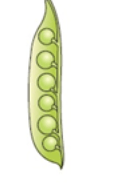
Answer-
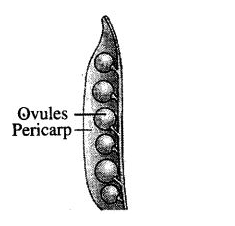
Q.12. Why is it so that the gametes produced in the organisms in large numbers exhibit external fertilization?
Answer- Producing a large number of gametes increases the chances of at least one sperm fertilizing the egg. Also, the gametes released can be affected by predators and desiccation. That is why the gametes produced in large numbers exhibit external fertilization.
Q.13. Identify the monoecious and dioecious organisms.
- Earthworm
- Chara
- Marchantia
- Cockroach
Answer- Earthworm- Monoecious Chara- Monoecious Marchantia- Dioecious Cockroach- Dioecious
Q.14. Match the following:
| Column A | Column B |
| Bryophyllum | Offset |
| Agave | Eyes |
| Potato | Leaf Buds |
| Water hyacinth | Bulbils |
Answer- Bryophyllum-Leaf Buds; Agave- Bulbils; Potato- Eyes; Water hyacinth- Offset
Q.15. Post-fertilization, what do the following parts of the flower grow into?
Ovary
Ovules
Answer- Ovary grows into a fruit. Ovule grows into a seed

 Easy Biology